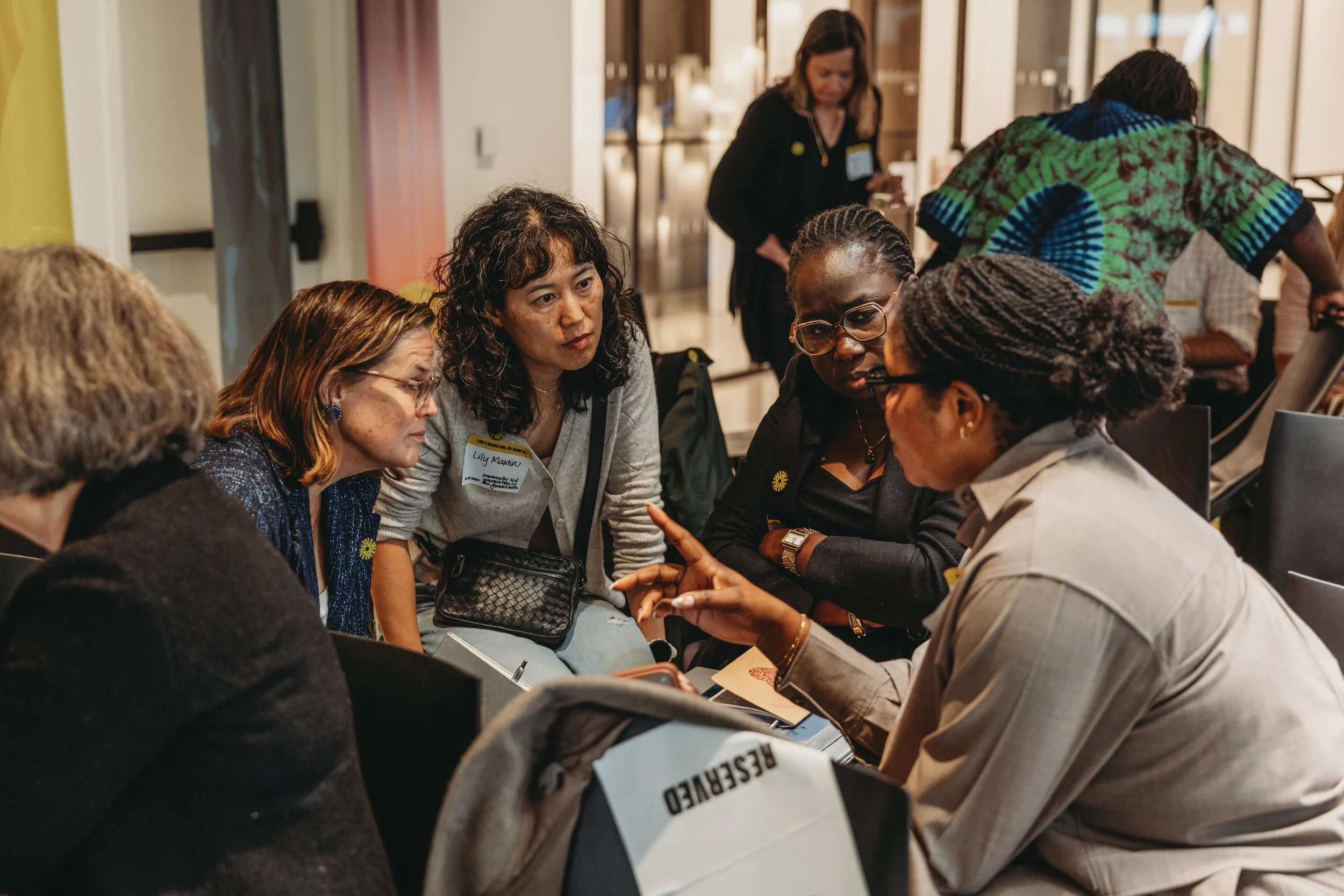
I spent a week in September in rooms where climate was the subject and action was the purpose.
New York Climate Week fills those rooms with people who have influence that could lead to urgently needed actions to address a global climate and nature crisis: investors, policymakers, scientists, business leaders and, of course, climate solutions-focused organizations like Project Dandelion, the woman-led climate justice movement I co-founded with Mary Robinson, Hafsat Abiola, and Ronda Carnegie.
For seven days, a few square miles of Manhattan holds an unusual concentration of people who can move capital, shift policy, or change what gets funded next. Proximity to that kind of power can be catalytic. The right dinner, the right panel, or just an elevator ride next to someone who could fund your next five years of work. I’ve seen the most consequential distance at Climate Week come down to about three feet.
Climate weeks are now being convened in many places, from Nairobi to London to San Francisco to New York, and this month, for the first time, in my hometown, Atlanta!
As more of these opportunities arise, climate organizations have more chances to turn the proximity these weeks provide into measurable outcomes for Planet Earth. Are we coming out of these rooms making real progress toward transitioning from the fossil fuels that are poisoning the planet and ourselves? Are we securing more funding for the devastating loss and damage of climate-related disasters in the places that contribute least to the pollution of our air and water? And what about the companies that pollute and profit while we keep buying their products and using their services?
We need urgent responses and action on these and all the other global challenges connected to the nature and climate crisis.
Planetary Guardians annual Planetary Health Check, prepared with a team of more than 60 of the world’s best environmental scientists, made it compellingly clear that we’re not moving fast enough, or engaging the cross-sector support necessary, to reverse the damage to the Earth’s life-sustaining ecosystems. This year’s report was indisputable evidence that we have transgressed seven of the nine planetary boundaries that sustain life on Planet Earth, and every one of those seven is moving deeper into the danger zone, toward the point where reversing the damage will not be possible. I doubt anyone left that theatre feeling better, but I hope many left ready to push for big changes at every level: government, business, community, individuals.
This report was shared with a full theatre during this most recent Climate Week. A theatre can be a distant way to share something: hundreds of people facing a single stage. The hope is that findings like these travel much closer than the back row, and continue to resonate and inspire more urgent responses. Of course, there are questions about what actions should be priorities and the reality of different solutions for different regions and cultures, but the call for all of us to become better informed and more active guardians of this formerly abundant planet is unmistakable. Other sessions focused on the facts about where we are: in danger of never getting back to 1.5°C (remember the “1.5 to Stay Alive” campaign?), and facing this year’s Super El Niño, with more floods, droughts and extreme weather everywhere.
We also need to give people reasons to feel good about progress, and there is good news to report: we have the solutions we need to solve this crisis. Focusing on the stories of solutions, and there are many of them, can be the inspiration needed to unlock capital and philanthropic funding, and to convince more people to move from concern to engagement and action.
Much of that good news is being carried by the next generation of leaders, who have picked up the climate justice torches. We haven’t abdicated ours, by the way, but we know that to get to the healthier, more sustainable Mother Earth they deserve, they will need a lot of light and optimism. I don’t mean rose-colored optimism built on a few happy stories of progress. I mean what Christiana Figueres calls “radical optimism,” courageous and unstoppable.
That kind of optimism has work to do: 89% of the global population say they are concerned about the climate and nature crisis, but less than 8% are active in doing anything to address the causes. That gap closes outside the rooms, back home, among the people we stand beside and are in community with.
I started this musing on the importance and impact of the climate week convenings because my co-founder Hafsat Abiola said to me, in the midst of my moving around Manhattan trying to be everywhere I thought might be worth listening or presenting: “New York is more than the US.” She meant it about Climate Week itself, how people converge here from everywhere, each one carrying a different read on where the field is actually heading. But it’s true of influence generally. Whatever room you’re standing in is never the whole picture. It’s briefly lit up with nice dinners, good company, even a gala or two, all of which can be easily mistaken for the whole story.
That’s why I’ve been suggesting that there is more to the power of proximity than we may be activating. There’s actually a name for the study of this. The anthropologist Edward T. Hall called it proxemics. Not to be confused with proprioception, our sense of where our own bodies are in space, proxemics is about the space between us, and what that distance communicates, both to the people we’re close to and to everyone watching. Hall believed distance is a language, and we’re all communicating through it without noticing. Stand twelve feet from someone, roughly the distance from a speaker at the podium to the front row of chairs, and you’re an audience. Move to arm’s length, close enough to shake a hand or catch a quiet word, and you’re in a conversation. Closer still, and what you’re sharing is trust. A week like Climate Week moves us through every one of those distances, from the theatre seat to the panel to the dinner table to the elevator, sometimes in a single afternoon.
Each of those distances has real value. From the audience, you hear the ideas. At arm’s length, you catch the aside after a panel ends, or meet someone you didn’t know you needed to meet. The danger is how convincing proximity can be: the people inside it start to believe the room is bigger than it is. Everyone at your table begins to feel like the whole field. By Wednesday, the handful of voices you’ve heard all week start to sound like the whole conversation, and it gets easier to forget why we’re in the room or to notice who isn’t.
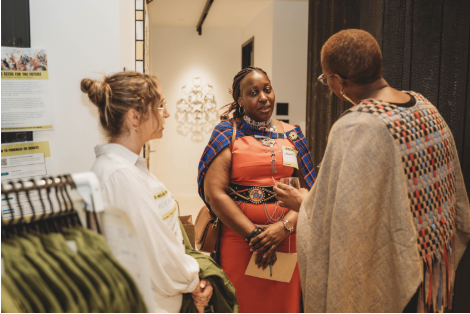
Some of those who were left off the invitation list tried to come in anyway. I watched more than one get escorted out of a room for saying, loudly and without permission, something the people inside hadn’t wanted to hear. They were finding their way into those rooms to be heard, not just to be proximate to the ones with power. They were closing a distance no one had offered to close for them. Some of the uninvited were speaking on behalf of people who have never gotten the badge, the seat, or a panel invitation.
I want to be specific about what I mean: not all disruption is the same, and I don’t think we should treat it as if it were. The disruption I respect hurts no one and puts no one at risk. It interrupts comfort, not safety. It’s a body standing up, a voice raised a decibel louder than the room wanted, someone refusing to leave quietly until the thing they came to say got said. I wouldn’t call that chaos. I’d call it a form of influence available to people who have exhausted every quieter means first.
I’m wary of romanticizing protest for its own sake, and volume alone doesn’t earn applause. But when distance is enforced by a locked door, sometimes volume is the only tool left to bridge the gap. The version I watched that week, the kind that costs the disruptor something and costs the room only its comfort, deserves a harder look than most of us give it. It’s one more reminder that influence doesn’t only belong to the people who got invited. Sometimes it belongs most to the people who weren’t invited and came anyway.
Every room, by definition, excludes someone. And even inside the room, it’s possible to be close without being connected. I’ve started thinking of it as ceremonial proximity, the way we talk about a ceremonial title: it has the form, but not the power. You can sit four feet from someone for an hour, facing the same stage, and never exchange a word, and you can leave a week like this with a full calendar and an understanding no wider than when you arrived, if the only people shaping your thinking are the ones who happened to be sitting close enough to talk to you.
The difference can be slight. The Planetary Guardians describe this year’s Planetary Health Check as putting data behind what frontline communities already know from living it. That idea stayed with me all week. Climate change reaches a community as a heat wave, a failed harvest, a dry well, a pregnant woman with nowhere to cool down, before it shows up in any report. The evidence is there, and so is the capital, and so is the resilience being built in those communities. What’s too often missing are the connections between them. Sometimes the whole difference between ceremonial proximity and the real thing is as simple as turning toward the people who are living it.
Hall’s insight was that how we use space tells the truth about our relationships. I think the same is true of influence. Proximity is space with power in it, and how we use it shows what we believe it’s for. That’s what I mean by stewardship of influence. If I get the seat, the badge, five minutes with someone who can move real money, that space isn’t mine to enjoy. It’s borrowed, a debt rather than a reward. And the way to repay it is to make room: to find the people who didn’t get a seat and bring them into the next room, so they can speak for themselves rather than others speaking for them.
People in the room notice when someone with influence stands beside someone without it. It tells everyone watching that this person belongs here. Proximity lends credibility the same way money does.
The next room is already on the calendar. When Climate Week comes to Atlanta this month, I want to measure it not by who I meet, but by who I help bring in.
This is the way we must convene for actionable influence during Climate Weeks and all other opportunities because, as the musical Hamilton reminds us, being in “the room where it happens” is our opportunity to change the rooms, as well as what happens.
Onward!
Pat

